




Talk to our composting expert
Visit the gardens Wednesday's before 11:00 am to learn more about composting techniques and approaches that are right for you!
Alpaca Beans
When it comes to manure for fertilizing your garden, there's nothing quite like alpaca poo -- or alpaca beans, if you're in the know. Depending on the source, alpaca beans can be an organic, nutrient-rich "cool" manure fertilizer.
Lori Lenhart at Serendipity Ranch and Cathy Kelekian both raise alpacas here in Montrose, and both have recently donated some of those magic beans to the Botanic Gardens' composting operation -- thank you so much! Our Compost Master, Art Clifford, along with Laulii and Mark Hillier, visited the ranch this past weekend, met the "bean-makers" in person, and then hauled a load to the Gardens.
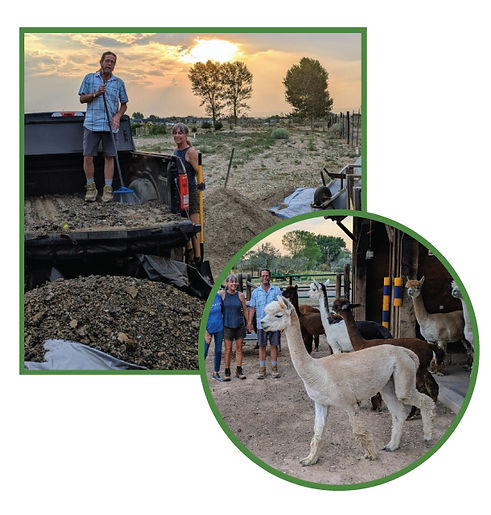
We're confident that, unlike cow or horse manure, this high quality alpaca manure would not need to be composted or aged before being applied in the garden. Alpaca beans are known for having almost no odor, and for being devoid of viable weed seeds as a result of the animal's efficient digestion.
Art will be incorporating these alpaca beans into the compost operation, however, to increase beneficial organisms and carbon content. He's also trying his hand at brewing some nutrient-rich alpaca bean tea for use in the gardens, which may steep for 24-48 hours depending on the recipe.

Bring us your compostables!
Drop off your all-natural scraps
to the Montrose Botanic Gardens compost area (southwest corner) on Wednesday mornings.
We only accept chemical free donations.
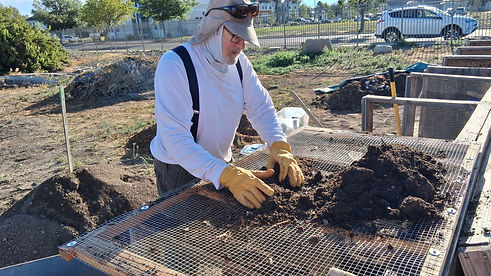
A Closer Look at
COMPOST
Early Beginnings
By Art Clifford
An early band of humans skirt the forest edge in search of resources. As the productivity of the area declines, they move on in their quest for food and game. At each encampment they leave behind their animal, vegetable and human refuse.
Many seasons later they return to the same location. The green food sources have been replenished and the game is once again abundant. Noticing an area of more productive herbs and fruiting shrubs, they realize this is the exact location of a previous midden, now covered with luxurious plant growth. As they depart this area, one member scatters a few seeds across their new midden. Speculation? Certainly, however, the benefits of compost are beginning to be revealed and will later be codified and scientifically studied by their progeny.
Eventually the diaspora of humanity settles across a wide range of territory. Some groups choose to remain in areas rich in resources. They have brought their cumulative experiences and teachings with them. The fertility of the area remains stable for they have learned how to use leaf mold, fish remains, crop residues and dung to enrich the soil in the fields that they plant and harvest yearly.
Early signs of composting predating written language occur in multiple cultures. These include the British Isles, Mesopotamia, the Indus Valley, the Americas, and ancient China, Rome and Greece.[1]
The earliest archaeological evidence of composting occurs in prehistoric Scotland in 12,000 B.C.[2] This is followed by the first written evidence of composting in Mesopotamia in 2300 B.C. during the Akkadian Empire.[3]
Early in our own country’s history, George Washington was an advocate and maker of compost on an impressive scale. Initially Washington’s fields were planted in tobacco. After several years the tobacco crop declined precipitously. He knew that dung from his livestock would improve the quality of tired soils and built an impressive stercorary (dung repository). In a “1787 letter to his farm manager, Washington outlined a meticulous construction plan: Masonry sides, a cobblestone floor sealed with clay to prevent nutrient loss, and an open-sided, shingled roof supported by brick pillars.”[4]
He also practiced crop rotation growing wheat, corn and other crops as he experimented with his fields. He corresponded with other farmers, including Thomas Jefferson, regarding various farming practices and the best methods of incorporating compost into the soil.
Composting as a scientific method is first documented by Sir Albert Howard (1873-1947) who, observing the agricultural practices of farmers in India, referred to them as “his professors of agriculture.”[5]
In 1931 Howard and his collaborator Yeshwant Wad authored a seminal work entitled, ‘The Waste Products of Agriculture.’ Together they developed what is now known as the ‘Indore Method’ of composting. During his tenure at the Institute of Plant Industry in Indore and 25 years in India, he published two more books, An Agricultural Testament and The Soil and Health, both of which were key texts in sustainable agriculture. The Indore Method uses various organic wastes that are shredded and then layered with manure, ash, chaff and wood chips in a shallow pit generally no greater than two feet in depth. The compost is then turned weekly to ensure oxygenation of the material for a three-month period. Composting that was previously widely practiced did not incorporate turning and the material required 6 to 12 months or more to mature into compost.[6]
Sir Howard’s research was followed in the 1950s by Dr. Clarence Golueke (1917-2004) of the University of California. Dr. Golueke spent 40 years in compost research. His influence spanned a wide range of waste treatment methods from compost to energy production. His findings culminated in the University of California’s ‘Berkeley Method of Composting’ which generates high internal temperatures (130-160 °F). This method prescribes frequent turning every one to three days in mounds or bins of at least 3 ft x 3 ft x 3 ft. The resulting high temperature due to microbial activity kills weed seeds and pathogens. It retains more nutrients and also yields fast, high quality compost in about 3 weeks.[7]
Two Compost Categories
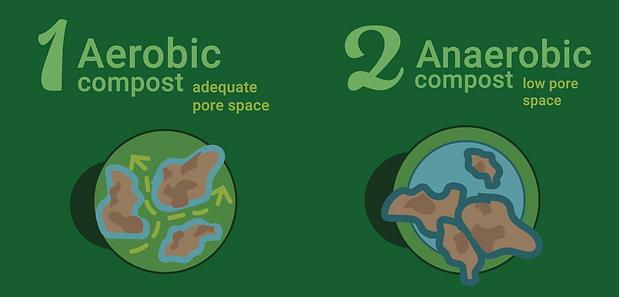
There are two modern categories of composting: aerobic (with oxygen) and anaerobic (without oxygen). Our discussion will be limited to aerobic composting which, with modern machinery, can produce compost on an industrial scale. There are four primary methods of producing compost aerobically on a large scale. From the least to most technologically advanced, the aerobic forms used in the U.S. are:
-
Aerated Windrow Composting: These are long mounds of compost with various materials like manure and residual material remaining after harvest. These are common on farms and use machinery such as front-end loaders, tractors, skid steers and more specialized machinery to accomplish the turning. Some windrows use perforated piping below the material to accelerate the process. This is the most common type of composting on large scales utilized in the United States.[8]
-
Aerated Static Pile Composting: Utilizes a series of perforated pipes or platforms which control airflow, temperature and moisture content by either positive, negative or reversing aeration. These systems require a smaller footprint than other traditional windrows, and decrease the amount of time required to make usable compost.[9]
-
In-Vessel Composting: These are the most technologically advanced systems of composting currently in use. They utilize huge closed rotating drums or silos or other containers such as shipping containers with agitators and aerators. Because the vessels are sealed, temperature, moisture, leachate and odor can be carefully regulated. This results in the fastest composting cycle of the four methods – 2 to 6 weeks.[10]
-
Commercial Vermiculture: Worm castings and worm tea are in high demand by organic farms as they are high in nutrients, bacteria and fine-textured.[11] This method has several key drawbacks, however, including climate sensitivity since high or low temperatures can kill the worms (Eisenia fetida – Red wigglers). It also requires large amounts of manual labor and the operations are complex. Additionally, the feedstock must be pre-composted to prevent killing the worms due to overheating or poisoning by toxic gases like excess ammonia (NH3).[12]
Science Behind Composting
The current science of composting has several key precepts.
ONE: The carbon (C) to nitrogen (N) balance (C:N).
It requires a balance point occurring at 25:1 to 30:1. Brown feedstocks, or the materials to be composted, are considered carbon-givers, and green feedstocks and manures are considered nitrogen givers. The C:N ratio is important because it ensures that the bacteria, yeasts and fungi necessary for composting have the nutrients necessary to reproduce. Carbon is an energy source and basic building block of cellular structure. It comprises approximately one-half of the mass of microbial cells. Nitrogen is a key component of proteins, amino acids and enzymes that ensure cell growth and metabolic processes. If the C:N is altered in favor of nitrogen, it creates odors and cytoxic ammonia gas (NH3).[13] A higher ratio of carbon (or brown materials) will stunt the growth of microbial colonies, and therefore the optimum temperature in compost of 130 to 160°F will not be achieved. This effectively increases the amount of time required for the feedstock to become compost.[14] Good sources of carbon are dry leaves, straw, woodchips and paper products. Good sources of nitrogen are manure, grass clippings and green plant material.
TWO: Oxygen through aeration.
While the microbial community harbored within compost can survive on as little as 5 to 10% oxygen (normal atmosphere is 21%), oxygen levels below 10% in the compost pile can become anaerobic and produce methane gas (CH4) and hydrogen sulfide (H2S). Oxygen accelerates the breakdown of organic matter and fuels microbial activity which raises heat, killing detrimental organisms and sterilizing weed seeds. According to CompostMagazine.com, good aeration is a must for successful composting.
THREE: Moisture content.
The best moisture content for compost is between 40% to 60%. This is approximated by the home composter as the dampness of a squeezed sponge. This level of moisture in the pile allows yeasts, fungi and bacteria to carry on necessary metabolic functions and to move through the medium on the water film. If moisture levels are too high, anaerobic conditions develop as water fills air spaces. If moisture levels are too low, the decomposition process slows dramatically. Compost material, when squeezed in the hand, should not release more than a drop or two of water. This approximates 65% moisture content. Although slightly out of the previously mentioned ideal range of 40 to 60%, it is appropriate for home composters in an arid area like Montrose. More specific measurement methods involve weighing moistened compost and then drying the material and subtracting that value from wet weight and then dividing by the initial net weight. Multiply by 100 and this product yield the percentage of moisture. ((Wet weight – Dry weight)/Original wet weight) x 100 = Percent moisture.
FOUR: Temperature
This is the best indicator of the efficiency of the composting process. Temperatures over 130°F for 72 hours continuously will eliminate most weed seeds and eliminate many harmful pathogens including fly larvae. There are three phases of temperature in composting: the Mesophilic (50° to 104°F), the Thermophilic (104° to 149°F) and the Curing Phase, during which temperatures decrease back to surrounding environmental levels. If temperatures remain too low, one of the other variables (i.e., C:N, moisture or oxygen) will be improper.[16]
When the prerequisites for composting are met, the microbes responsible for the process begin to metabolize carbon and nitrogen, and spread rapidly through the medium. In addition to microbes, yeast and fungi, springtails (Collembola) help to reduce the material from the optimum starting size of ½” to 1½” feedstock to smaller sizes allowing the bacteria to breakdown the lignin.[17] Lignin is a tough, organic polymer that gives plants their rigid structure. Accounting for 20% to 35% of dry plant mass, lignin forms the vascular tissues that transport water and minerals upwards (xylem) and distribute the photosynthetically produced sugars and amino acids downwards (phloem) to the roots.
The Rhizosphere
The rhizosphere is the rooting zone of plants and the central processing mechanism of the root microbiome which includes and is extended greatly beyond the plant roots by bacteria, fungi and other microorganisms, including the archea and nematodes. Although the understanding of the rhizosphere is still in its infancy, it is referred to as “the second genome of the plant.”[18] The rhizosphere is divided into three zones which overlap:
-
The Endorhizosphere: The space within plant roots that fuel the plant.
-
The Rhizosplane: The root surface and any secretions (rhizodeposits) from the plants.
-
The Ectorhizosphere: The outermost zone of soil from the roots surface.
A true exploration of the rhizosphere, which is still currently ongoing, is outside the scope of this article. However, it is briefly defined as the interface between a plant’s roots and the environment.
Very basically, the rhizosphere exchanges photosynthetically produced carbon (i.e., sugars) and releases them into the soil, thus providing the microbial community with the energy for metabolism. In return, that community assists the plant with the acquisition of nutrients from the soil.[19] These nutrients are made available to the microbes by chemical fertilizers OR most importantly by compost, which also accomplishes the other functions previously discussed in this article.
Compost works in the soil when incorporated into the soil by tilling 1/3 by volume 6” to 8” deep, top dressing or using in planting holes in the spring or fall. Compost imparts numerous benefits to all types of soils. According to the U.S. Composting Council, “compost promotes healthier plant growth, balances soil density, enriches the soil, balances pH, aids in water retention and suppresses disease and pests.”[20] The E.P.A. states that composting protects the climate by decreasing methane emissions, reducing waste, recycling organic materials into a valuable soil amendment, recovering nutrients in organic materials while keeping them local, and extending municipal landfill life by diverting organic materials.[21]
Now having a very rudimentary understanding of the importance and complexity of the rhizosphere, we can begin to realize the importance of incorporating compost into our soils.
Clearly plant science has journeyed far since our ancestors first suspected the benefits of recycling and incorporating composts into the soil. We are fortunate to have such an amazing resource available. Hopefully we will utilize it fully.
FOOTNOTES
-
‘The History of Home Composting: Stone Age to Revolutionary America.’ Elevate Blog, Sept. 13, 2023. https://elevatepackaging.com/blog
-
National Geographic. ‘The Green, Brown and Beautiful Story of Compost,’ P. Aaron Sidder. Sept. 9, 2016. https://www.nationalgeographic.com
-
George E. Fitzpatrick; Eva C. Worden; and Wagner A. Vendrame. ‘Horticultural Development of Compost Technology during the 20th Century.’ Hort Technology, January 2005, IS(1):48-51.
-
Rober Arner, ‘George Washington: The Composter of our Country.’ Re-gain Enterprise, Sept. 11, 2025.
-
Keith Addison, ‘Journey to Forever.’ Handmade Projects, Online Library. June 17, 2026.
-
https://en.wikipedia.org/wiki/Albert_Howard. June 18, 2026.
-
Kate Atchley, ‘Hot Composting with the Berkley Method.’ The Kerr Center for Sustainable Agriculture, www.kerrcenter.com. August 2023.
-
‘Sustainable Management of Food.’ Environmental Protection Agency, epa.gov/sustainable-management-food/composting. June 15, 2026
-
‘Aerated Static Pile.’ Circea Mountain Technologies. https://compostingtechnology.com. June 15, 2026.
-
Engineered Compost Systems. https://compostsystems.com. June 16, 2026.
-
Uncle Jim’s Worm Farm, Uncle Jim’s Blog. https://unclejimswormfarm.com. June 21, 2026.
-
Urban Worm Company. https://shop.urbanwormcompany.com. June 21, 2026.
-
National Institutes of Health. http://pmc.nbi.nih.gov. Articles PMC 12278057. June 22, 2026.
-
Cornell Composting Science and Engineering. Compost.css.cornell. August 24, 1995.
-
‘Agricultural Composting and Water Quality.’ Oregon State University. https://extension.oregonstate.edu. June 2026.
-
Tom Richard, Cornell Cooperative Extension Operator’s Fact Sheet No. 5 of 10. Cornell Composting Science and Engineering. Compost.css.cornell.edu. August 24, 1995.
-
Nathaniel Corrow, ‘Isopod and Springtail Handbook,’ page 10. 2026.
-
www.sciencedirect.com/article/abs/pii/S136013851200799. Volume 17, Issue 8, August 2012, pgs 478-486.
-
Nature.com/suitable/knowledge/library/the-rhizosphere-rocks-soil-and-67500617/, David H. McNear. June 24, 2026.
-
U.S. Composting Council, https://compostingcouncil.org. June 2026.
-
U.S. Environmental Protection Agency. https://www.epa.gov/sustainable-management-food/benefits-using-compost. June 2026.